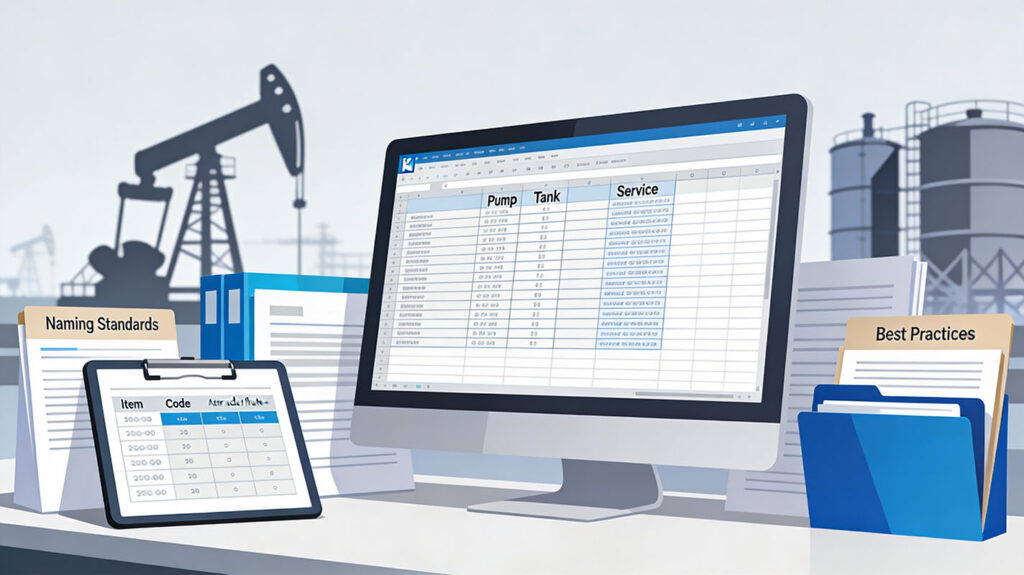
Unifying Item Naming Across the Organization
Unification is both a data project and a governance discipline. Here’s a practical approach.
Step 1: Define a Standard Naming Schema
Start with a simple, human-readable pattern that supports searching and categorization. For example:
• Rental Units Category – Capacity/Size – Key Attributes – Configuration
- Pump 10×8 2250 HP Diesel
- Tank 400 BBL Skid Sour Service
- Light Tower LED 6kW Trailer
• Consumables Category Size Rating Material Application
- Iron 2″ 1502 Fig 1502 Sour Service
- Hose 2″ x 50′ 5000 PSI Hydraulic
- Chemical Scale Inhibitor 5 Gal Pail
• Services Service Type – Level – Location/Shift – Billing Basis
- Field Technician – Senior – Day Rate
- Rig Up/Rig Down – Per Job
- Engineering – Reservoir – Hourly
The pattern should be human-readable, easy to search, and consistent across lines of business.
Step 2: Separate Item Code from Item Name
Item codes/IDs should be stable and integration-friendly; item names should be descriptive and user-friendly.
• Item Code (system key)
- Short, structured, no spaces, no special characters that break integrations.
- Example: PUMP_10X8_2250HP_DIESEL, TNK_400BBL_SOUR, SRV_FTECH_SR_DAY.
• Item Name (human-facing)
- Follows your standard schema.
- Example: Pump 10×8 2250 HP Diesel.
All systems should integrate on code, not free-text name. Names can evolve; codes should not.
Step 3: Design a Minimal Attribute Model
Don’t rely on names alone. Attach structured attributes that support filtering, reporting, and integrations:
• Common attributes for rental units:
- Category (Pump, Tank, Iron, Light Tower)
- Capacity/Size (e.g., 400 BBL, 10×8, 2″)
- Pressure rating/HP
- Sour vs. sweet service
- Asset class and GL mapping
• For consumables:
- Category (Hose, Fitting, Chemical, Electrical)
- Size and rating
- Unit of measure (EA, FT, GAL, L)
- Storage location (warehouse, yard)
- Preferred vendor
• For services:
- Service type (Field Tech, Engineering, Training)
- Level/seniority
- Billing basis (hourly, day rate, per job)
- Cost center/department
These attributes power better search in CRM, job planning, and ecommerce catalogs.
Step 4: Clean and Consolidate Existing Items
Before enforcing conventions going forward, you’ll need to clean what you already have:
1. Export item master from your key systems (ERP, job management, accounting).
2. Identify duplicates where:
- Names differ but describe the same equipment.
- Slight spelling or abbreviation differences exist.
3. Group and merge:
- Choose a single standard item code and name.
- Map old codes to new ones for historical data (or mark as obsolete).
4. Align GL and tax mappings:
- Ensure each item points to correct revenue accounts, tax codes, and cost centers.
This is often a one-time project that pays off in every future integration and reporting initiative.
Step 5: Implement Governance and Ownership
Naming conventions only work if someone owns them. Establish:
• Item Master Committee or at least a single Item Data Steward.
• A simple approval workflow for new items:
- Check for duplicates.
- Validate name format against standards.
- Assign correct code, category, and GL mapping.
• Documentation:
- One-page naming standard.
- Examples of correct vs. incorrect names.
- Rules for abbreviations and units.
Make it easy for frontline teams to request new items—but impossible to bypass the convention.
How Naming Conventions Support Key Systems
CRM and Quoting
In CRM, sales and business development teams need to build quotes quickly and accurately:
- Browsing item categories and templates for common job packages.
- Searching by capacity, size, or common field terminology.
- Reusing standard bundles (e.g., “Frac Spread Package,” “Standard Flowback Package”).
Standardized names and attributes enable CRM to:
- Auto-suggest items.
- Build repeatable quote templates.
- Provide consistent pricing across reps and regions.
ERP and Inventory
ERP tools rely on clean item masters for:
- Purchasing and reordering.
- Warehouse transfers and stock levels.
- MRP/forecasting.
Standardized naming ensures:
- Planners and buyers recognize items across locations.
- Duplicate stock is minimized.
- Consolidated purchasing power is visible.
Accounting and Billing
Accounting systems and billing tools need:
- Stable item codes for mapping to GL accounts.
- Clear item names to appear on customer invoices.
- Tax and revenue recognition rules tied to item types.
With consistent naming and coding:
- Revenue by item category (e.g., Tanks, Pumps, Services) is clear.
- Margin analysis by product line becomes reliable.
- Audits and external reporting are easier to support.
Ecommerce and Customer Portals
If customers can request equipment or services online, item naming becomes marketing collateral:
- Names must be clear to non-technical users.
- Categories and filters must align with how customers think.
- SEO considerations may apply if the catalog is public-facing.
A good convention is both internal-friendly (structured, consistent) and customer-friendly (understandable, unambiguous).
Equipment Tracking and Telematics
Asset tracking systems tie real-world equipment performance to items and jobs:
- Runtime, fuel usage, geolocation.
- Maintenance schedules and inspections.
- Certification and compliance documents.
When item codes and names align with your asset registry:
- You can link telemetry data back to item-level profitability.
- Maintenance and rental utilization reporting become trustworthy.
- Field teams can identify the right unit quickly when issues arise.
Best Practices for Oilfield Item Naming
Here’s a concise checklist tailored for oilfield rental and service companies:
1. Separate Code and Name
- Code: stable, system-facing, no spaces.
- Name: human-readable, structured, and searchable.
2. Use a Standard, Documented Pattern
- Rentals: Category – Capacity – Key Attributes – Configuration.
- Consumables: Category – Size – Rating – Material – Application.
- Services: Service Type – Level – Billing Basis – Optional Location.
3. Be Consistent with Units and Abbreviations
- Pick one format: 2″, not 2 in/2in/2 inch.
- Standardize BBL, PSI, HP, GAL, L, EA, FT, M, etc.
- Avoid local slang when it confuses other regions.
4. Front-Load the Most Important Search Terms
- Put category and capacity/size at the beginning.
- Example: Tank – 400 BBL – Skid, not Skid Tank – 400 BBL.
5. Keep Names Concise but Informative
- Include enough detail to distinguish variants.
- Avoid overloading names with internal codes or notes.
6. Attach Structured Attributes Instead of Stuffing Names
- Use fields for category, size, rating, service type, etc.
- Names should be readable; attributes do the heavy lifting in reporting.
7. Align with GL, Tax, and Cost Structures
- Map each item to a revenue/cost account.
- Use consistent item categories for P&L by product line.
8. Govern New Item Creation
- Require central approval before items go live.
- Run quick checks for duplicates.
- Enforce naming rules in ERP/job management.
9. Design for Integration from Day One
- Decide which system is the item master (source of truth).
- Ensure every downstream system references the same item codes.
- Avoid renaming codes; adjust only names and descriptions where needed.
10. Review and Clean Annually
- Archive obsolete items.
- Merge duplicates.
- Adjust categories as your business evolves (e.g., new service lines).
Conclusion: Naming Conventions Are a Strategic Asset
For oil and gas service companies, item naming conventions are not a clerical detail—they’re a strategic asset:
- They reduce friction for sales, dispatch, and field operations.
- They improve billing accuracy and revenue recognition.
- They make integrations between CRM, ERP, accounting, billing, ecommerce, and equipment tracking more reliable.
- They unlock clean reporting on utilization, margin, and growth.
If your team struggles with duplicate items, confusing invoices, or mismatched reports across systems, a disciplined approach to item naming and master data governance is one of the highest-ROI fixes you can implement.
Start small: standardize naming for your top 50–100 revenue-driving items, align them across systems, and enforce the pattern for all new items. The operational clarity—and financial insight—you gain will cascade through the rest of your business.