What ISO 55001:2024 means for oilfield service and rental companies, and why your AI plans depend on it.
By Michael Maltsev, CEO, RigER
ISO 55001:2024 doesn’t ask a rental company to buy anything. It asks you to know what you own and where it is, whether it’s fit to run, what it earns and why you decided its fate. Most of that is already written on your tickets.
One frac valve, five jobs in the Permian
Follow one frac valve through five jobs in the Permian.
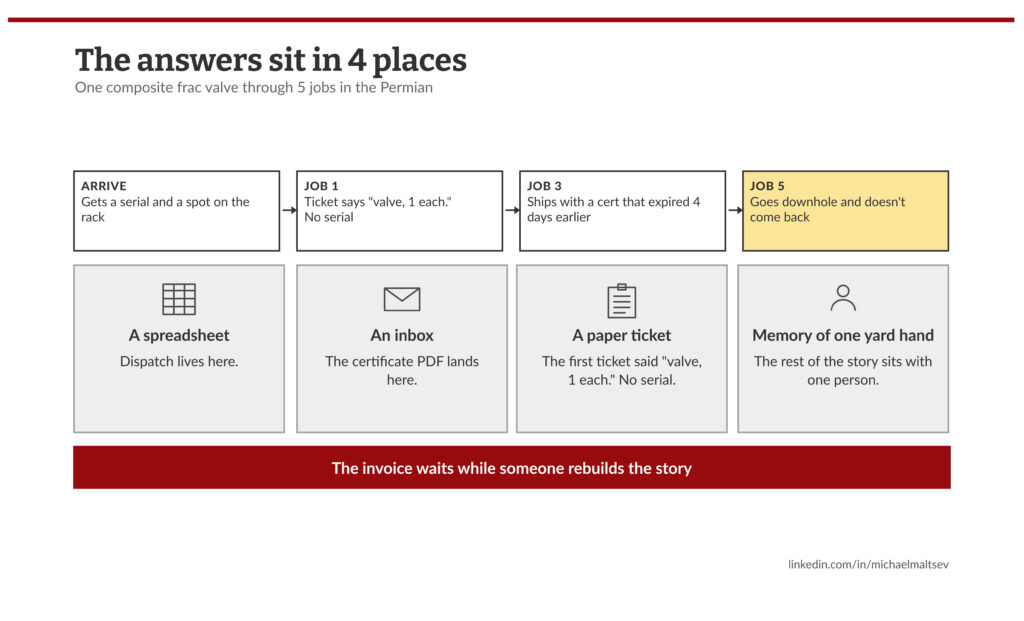
It arrives at a rental yard in Odessa. It gets a serial number, a line on a spreadsheet and a spot on the rack.
On its first job, the field ticket says “valve, 1 each.” No serial.
The valve comes back, goes to the inspection shop and gets a new certificate. The PDF lands in someone’s inbox.
On its third job, it ships with a certificate that expired four days earlier. Nobody catches it. The cert lives in email. The dispatch lives in a spreadsheet.
On its fifth job, it goes downhole and doesn’t come back.
Now the controller has questions. What replacement value does the contract allow? Which well, which customer, which day? What did this valve earn over its life? Was it in cert when it went in?
The answers sit in four places: a spreadsheet, an inbox, a paper ticket and the memory of one yard hand. The invoice waits while someone rebuilds the story.
That valve is a composite. Anyone who has sat in the CFO chair at a rental company has lived some version of it. I did.
![image]()
A standard written for plants just became a fleet problem
When people in our industry hear ISO 55000, they think refineries, pipelines and power grids. Fair enough.
The standard grew out of
PAS 55, a British specification first published in 2004. It became ISO 55000, 55001 and 55002 in 2014.
On July 3, 2024, ISO
launched new editions of ISO 55000 and ISO 55001 ISO 55001 is the one you certify against. Certificates to the 2014 edition expire on July 31, 2027.
What changed in ISO 55001:2024
The 2024 edition reads like it was written by someone who chased that valve through four systems. Four changes matter for a fleet that moves.
Clause 4.5: decision-making
You now need a documented way to decide. Repair, re-certify, retire or sell has to follow stated criteria, not a gut call in the yard.
Clause 7.6: data and information
Configuration is now called a key capability. Which components sit in which assembly, which parts were swapped, and when.
Clause 8.1: life cycle
The full life cycle is spelled out, from acquisition through use, maintenance and renewal to disposal. In our world, disposal includes lost in hole.
Clause 10.3: predictive action
It replaces preventive action. You’re expected to predict how your assets will behave and use that in your decisions.
Assurance is now an outcome
One more shift is easy to miss. In the 2014 edition, assurance sat with value, alignment and leadership as a core principle. ISO’s committee now treats assurance as an outcome. You don’t declare it. You prove it with records.
Who actually certifies in oil and gas
Verified certificates in oil and gas are fewer than the conference slides suggest.
ADNOC companies lead. ADCO, now ADNOC Onshore, certified in 2014. Trade press called it the first oil and gas company in the Gulf to do so.
ADNOC Gas reports ISO 55001 among the certifications covering 100% of its assets and operations in its 2024 Integrated Report. Petrobras certified its thermoelectric generation assets in September 2024.
For most of the other big names, I found alignment, not public certificates. ISO keeps no central registry, so a missing press release proves nothing. But I wouldn’t tell a contractor that Aramco or Shell requires ISO 55001 from its rental suppliers. I haven’t seen a tender document that says so.
The most useful names for us are smaller. ISO’s own committee lists three Australian drilling contractors under oil and gas: Easternwell, Wallis Drilling and Ausdrill NorthWest.
Service fleets. Assets that move. That’s the proof a company like yours can run this system.
Your tickets already hold the asset’s life story
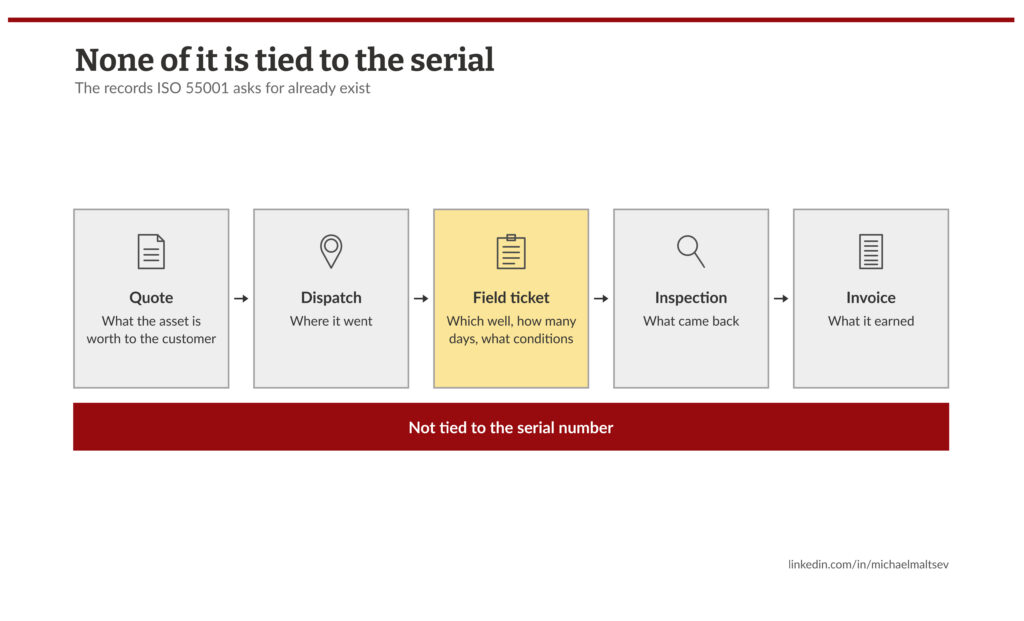
In most mid-size service and rental companies I see, the records ISO 55001 asks for already exist.
- The quote says what the asset is worth to the customer.
- Dispatch says where it went.
- The says which well, how many days and under what conditions. field ticket says which well, how many days and under what conditions.
- The inspection report says what came back.
- The invoice says what it earned.
None of it is tied to the serial number. Each record serves one job and then sits in its own system. Your field tickets are your asset register. Most companies haven’t connected them yet.
![image]()
Lost in hole: why the replacement rule belongs next to the serial
Lost in hole shows why this matters. To a CFO, a lost tool is three events at once: a write-off on the balance sheet, a line on the revenue report and an entry in the risk file.
Contract terms vary widely, which is why the rule has to live next to the asset. Tasman Oil Tools, an Australian rental company, publishes terms that charge landed replacement cost plus handling, typically 15%, when no value is stated. Lory Oilfield Rentals in Canada charges full rental until the lost item is replaced.
If the replacement rule doesn’t sit next to the serial, your controller rebuilds it from the contract every time. The invoice waits.
AI can’t fix what the field never captured
Most service company owners I meet want predictive maintenance. The best-known benchmark is strong. McKinsey reported in 2017 that predictive maintenance typically cuts machine downtime by 30 to 50% and extends machine life by 20 to 40%. Those numbers came from heavy fixed equipment with sensors and years of clean history.
Most rental tools have no sensor. A frac valve doesn’t send telemetry. Its usage history is the ticket: which well, how many days on location, what pressure rating, what came back damaged and why. That’s the training data, and it has to be structured first.
A repair written as “replaced seals, ok” teaches a model nothing. A repair coded by failure mode, cause and action teaches it a lot. ISO 14224, the oil and gas standard for reliability and maintenance data, already gives you that vocabulary.
Precision matters more than hype. In a rental fleet, a false alarm pulls a good tool off rent. A model that flags healthy tools costs you revenue.
The same holds for AI agents. An agent that schedules inspections or checks invoices needs clean records and written rules before it can act. ISO 55001 asks for both. For where your data needs to be first, see why data maturity comes before AI in oilfield services.
Three steps to start this quarter
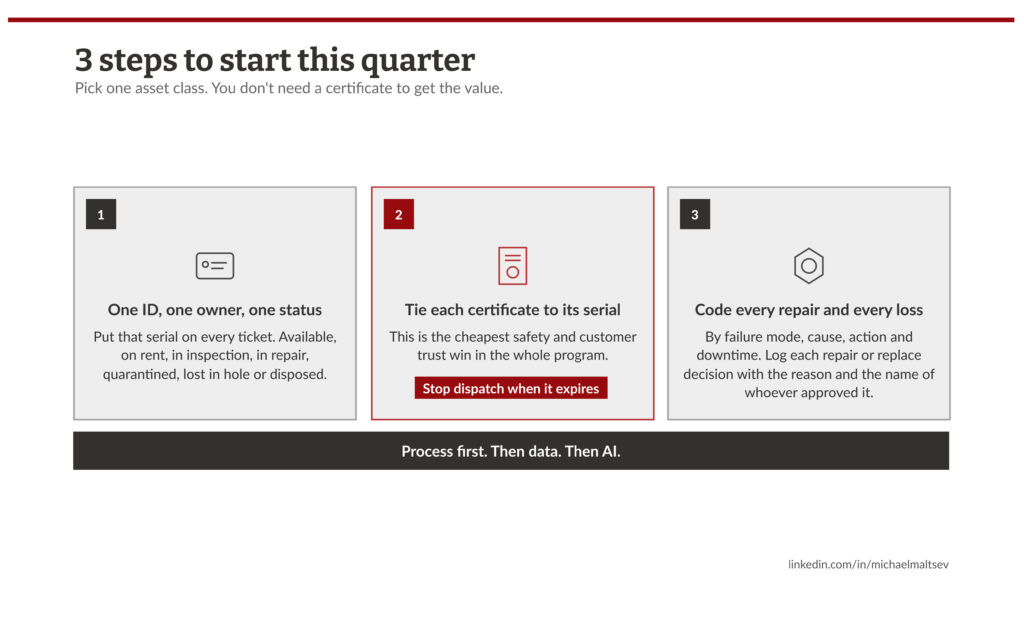
You don’t need a certificate to get the value. Pick one asset class and start there.
![image]()
1. Give every asset one ID, one owner and one status
1. Give every asset one ID, one owner and one status
Do this for every asset worth tracking. The statuses are available, on rent, in inspection, in repair, quarantined, lost in hole or disposed. Put that serial on every ticket. For tagging options, see our
RFID vs. QR field test for oilfield equipment.
2. Tie each certificate to its serial
Stop dispatch when the certificate expires. This is the cheapest safety and customer trust win in the whole program.
3. Code every repair and every loss
Code them by failure mode, cause, action and downtime. Log each repair or replace decision with the reason and the name of whoever approved it.
When ISO 55001 certification makes sense
Decide on certification with a simple rule. If two or more of your major customers manage their own assets to ISO 55001, or their tenders score asset management, certify. If not, run the system anyway and put the evidence in your bids.
Process first. Then data. Then AI.
This article was originally published on
LinkedIn on November 23, 2026.