An oilfield service company running paper tickets loses money in two places. Tickets that never make it from the field to billing cost 2 to 4 percent of revenue, industry average. Invoices that miss the operator’s contractual submission window cost another 1 to 3 percent, written off entirely. Neither number appears on the P&L as a line item. Both come out of the owner’s pocket.
RigER closes both gaps. The field ticket your tech signs at the wellsite becomes the invoice your customer receives. No re-keying. No spreadsheet bridge. Same week the job closed, often the same day.
Paper-driven shops in oil and gas average 65 to 75 days DSO. Companies running connected field-to-finance operations sit at 35 to 45. On a $40M revenue shop, every 10 days of DSO ties up roughly $1.1M of working capital. The math scales down too. A $4M shop carrying 30 extra days of DSO has about $330K sitting in customers’ AP queues instead of its own account.
Oilfield billing software earns its keep on that spread, not on the license price.
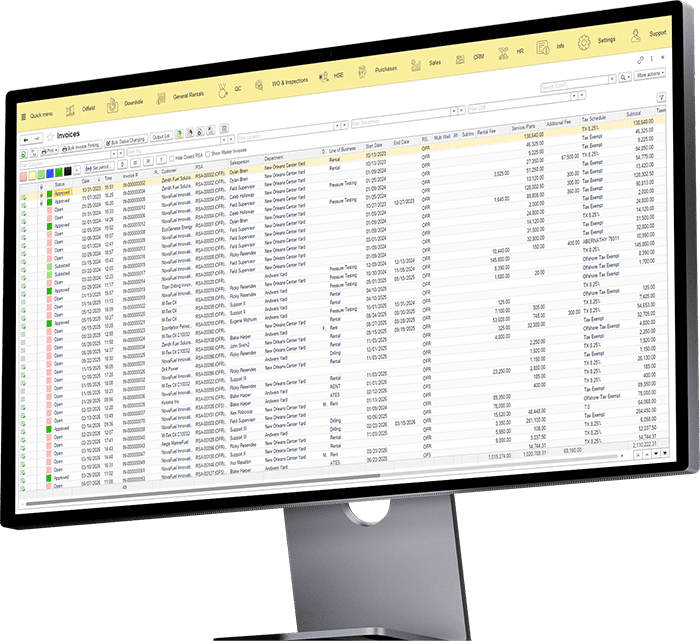
One operator, six wells on a pad, three service lines, dozens of consumables allocated by well. Built by hand in Excel, that invoice takes an AR clerk about six hours. Built from RigER tickets that captured allocation at the source, it takes fifteen minutes, with master and sub-invoices tied to the operator’s AFE.
The invoice then goes where the operator wants it. RigER feeds OpenInvoice, Cortex, and other AP portals in the format they expect, with supporting tickets attached. Fewer rejections, and fewer charges that quietly expire while a dispute drags on.
Your accounting system stays the system of record
RigER doesn’t replace QuickBooks, Sage, Business Central, or NetSuite. It sits upstream and feeds them clean invoice data. Operational truth lives in RigER; posted financials live in your ERP. Your bookkeeper stops re-keying tickets, and month-end close stops depending on a folder of paper nobody has typed in yet.
Frequently asked questions
Can we invoice the same day the job closes?
Yes, when the ticket is complete and approved. Same day invoicing in oilfield services depends on one thing: whether the billing data exists in structured form when the job ends. With RigER it does.
How does a field ticket become an invoice?
The approved ticket’s line items flow directly into an invoice draft: labor, equipment time, consumables, agreed rates. You review, adjust if needed, and send. Nothing is typed twice.
Does RigER connect to QuickBooks?
Yes. Invoices post to QuickBooks Online automatically, with customers and items matched. Sage and Business Central integrations work the same way. Details on the integrations page.
We bill through OpenInvoice. Does that change anything?
No. RigER generates the invoice and supporting documents in the format your operator’s portal requires, so submissions stop bouncing for formatting reasons.
How long before we send our first invoice from RigER?
It depends on fleet size and how your pricing is structured. Most teams are creating live field tickets within the first weeks of onboarding, and the first invoices follow as soon as those tickets close.
How is this different from your invoice generator?
The invoice generator is a free tool for producing a single invoice document. This page describes the full billing workflow inside RigER: tickets, approvals, master and sub-invoices, portal submission, and accounting sync for the whole operation.